The Loewner Framework: Data-Driven Model Reduction for Control of Complex Systems
From Theory to Hands-on Implementation
Simplified model construction and model order reduction is essential for making complex systems tractable for control design, optimization, and (uncertain) simulation, yet many real-world systems remain too large or unwieldy for standard approaches.
In this context, the Loewner Framework (LF) offers a data-driven, scalable solution allowing constructing accurate surrogate models directly from measured data using only basic linear algebra (e.g., SVD), without iterations or optimization.
This makes it uniquely suited for very large, infinite and data-driven systems where traditional methods fail.
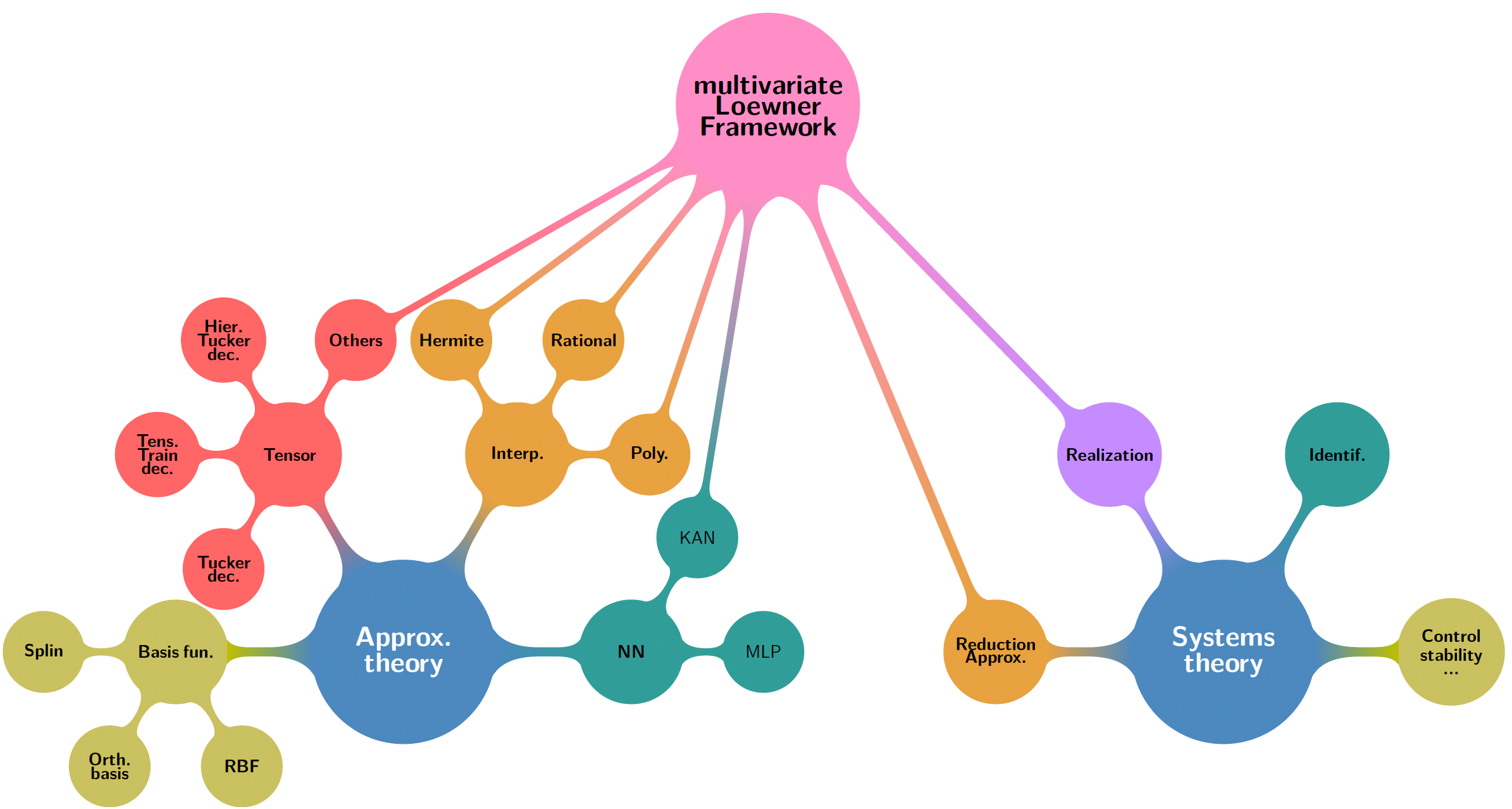
Originally developed for linear time-invariant (LTI) systems, the LF has since been extended to nonlinear systems, bridging approximation theory and dynamical systems through rational interpolation and minimal realizations. Its versatility is demonstrated across academic and industrial applications, from aerospace to energy systems.
This workshop is destined to researchers, PhD candidates and engineers working with
>> high-order systems or,
>> frequency-domain input-output data,
who need simplified models for control, optimization, analysis or simulation. It will equip participants with:
>> A theoretical foundation in the Loewner Framework for both linear and nonlinear time invariant systems;
>> Hands-on implementation skills using open-source MATLAB tools;
>> Practical experience reducing complex systems from benchmarks, or their own data, during interactive sessions.
The Loewner matrix is the main ingredient for rational approximation in the barycentric form:
$$
\text{Data $\{x_l,y_l=g(x_l)\}_{l=1}^N$ are split into columns $\{\lambda_j,w_j\}$ and row data $\{\mu_i,v_i\}$ leading to}
$$
$$
\mathbb{L} = \left[ \begin{array}{cccc} \dfrac{v_1-w_1}{\mu_1-\lambda_1} & \dfrac{v_1-w_2}{\mu_1-\lambda_2} & \cdots & \dfrac{v_1-w_k}{\mu_1-\lambda_k} \\
\dfrac{v_2-w_1}{\mu_2-\lambda_1} & \dfrac{v_2-w_2}{\mu_1-\lambda_2} & \cdots & \dfrac{v_2-w_k}{\mu_1-\lambda_k} \\
& & \vdots & \\
\dfrac{v_q-w_1}{\mu_q-\lambda_1} & \dfrac{v_q-w_2}{\mu_q-\lambda_2} & \cdots & \dfrac{v_q-w_k}{\mu_q-\lambda_k} \end{array}\right] \in \mathbb{C}^{q\times k}
$$
If you want to discover the Loewner features and wide applications, visit the ECC webpage