Porous irrational and multivariate example
Define the porous irrational functions
Start by defining the model through the two following irrational functions, $\alpha$ (dynamic viscous tortuosity) and $\beta$ (dynamic thermal compressibility),
$$
\begin{array}{rcl}
\alpha(x_1,x_2,x_3,x_4) = \alpha(\omega,\sigma_r, \phi, \overline{r}) &=& \dfrac{e^{4S_2}}{\phi}\left[1+\dfrac{a_1}{\imath\omega\overline{r}^2}e^{6S_2}+\dfrac{a_1 e^{6S_2}\sqrt{1+\dfrac{\imath\omega\overline{r}^2}{2a_1}e^{-7S_2}}-1}{\imath\omega\overline{r}^2}\right]\\
\beta(x_1,x_2,x_3,x_4) = \beta(\omega,\sigma_r, \phi, \overline{r}) &=& \phi\gamma-\phi(\gamma-1)\left[1 +\dfrac{a_2 e^{-2S_2}}{\imath\omega\overline{r}^2}+\dfrac{a_2e^{-2S_2} \sqrt{1+\dfrac{\imath\omega \overline{r}^2e^{3S_2}}{a_3}}-1}{\imath\omega \overline{r}^2}\right]^{-1}
\end{array}
$$
where, $S_2 =\left(\sigma_r\log_{10}2\right)^2$ and
where $\omega\in[10^{-2},10^8]$ is the frequency [rad/s], $\sigma_r\in[0.6,0.99]$ is the porosity, $\phi\in[10^{-6}, 10^{-2}]$ is the pore mean size and $\overline{r}\in[0,0.5]$ is the pore standard deviation.
The functions are given in Matlab form
here.
%%% Bounds
w_bnd                	= [1e-2 1e8];
porosity_bnd            = [.6 .99];
pore_mean_size_bnd      = [1e-6 1e-2];
pore_standard_dev_bnd   = [0 .5];
%%% Interpolation points
ip{1,1} = 1i*logspace(log10(w_bnd(1)),log10(w_bnd(2)),50);
ip{2,1} = linspace(porosity_bnd(1),porosity_bnd(2),10);
ip{3,1} = logspace(log10(pore_mean_size_bnd(1)),log10(pore_mean_size_bnd(2)),20);
ip{4,1} = linspace(pore_standard_dev_bnd(1),pore_standard_dev_bnd(2),20);
for ii = 1:length(ip)
    p_c{ii} = ip{ii}(2:2:end);
    p_r{ii} = ip{ii}(1:2:end);
end
%%% Define the alpha and beta functions
H_alpha = @(x)      fun.dynamic_viscous_tortuosity(x(:,1), x(:,2), x(:,3), x(:,4));
H_beta  = @(x) fun.dynamic_thermal_compressibility(x(:,1), x(:,2), x(:,3), x(:,4));
%%% Data tensor
[y,x,dim]   = mlf.make_tab_vec(H_alpha,p_c,p_r);
tab_alpha   = mlf.vec2mat(y,dim);
[y,x,dim]   = mlf.make_tab_vec(H_beta,p_c,p_r);
tab_beta    = mlf.vec2mat(y,dim);
Then, the tensorized data
tab_alpha and
tab_beta are constructed. Here leading to two 4-D tensors, with the following complexity
$$
\mathcal T_4^{\otimes} \in \mathbb C^{50\times 10\times 20 \times 20}
$$
Use the mLF (Alg. 1: direct [A/G/P-V, 2025])
Now we are ready to build the approximation.
The
opt.method is used to select either the recursive (
'rec') or full (
'full') method.
Here the latter is used and results in better results (still to be understood).
The
opt.data_min is used to use all data in the null-scapce computation (requires more CPU but may result in a least square averaging).
The
opt.ord_obj is used to specify the complexity along each variables.
Here it should be noticed that due to the irrational structure, order is not straightforward.
opt.method_null = 'svd0';
opt.method      = 'full';
opt.ord_obj     = [9 1 5 6];
opt.data_min    = false;
[r_alpha,imlf]  = mlf.alg1(tab_alpha,p_c,p_r,opt);
opt.ord_obj     = [8 1 6 5];
[r_beta,imlf]   = mlf.alg1(tab_beta,p_c,p_r,opt);
Evaluate the resulting approximate
Now we compare the original data and approximate functions.
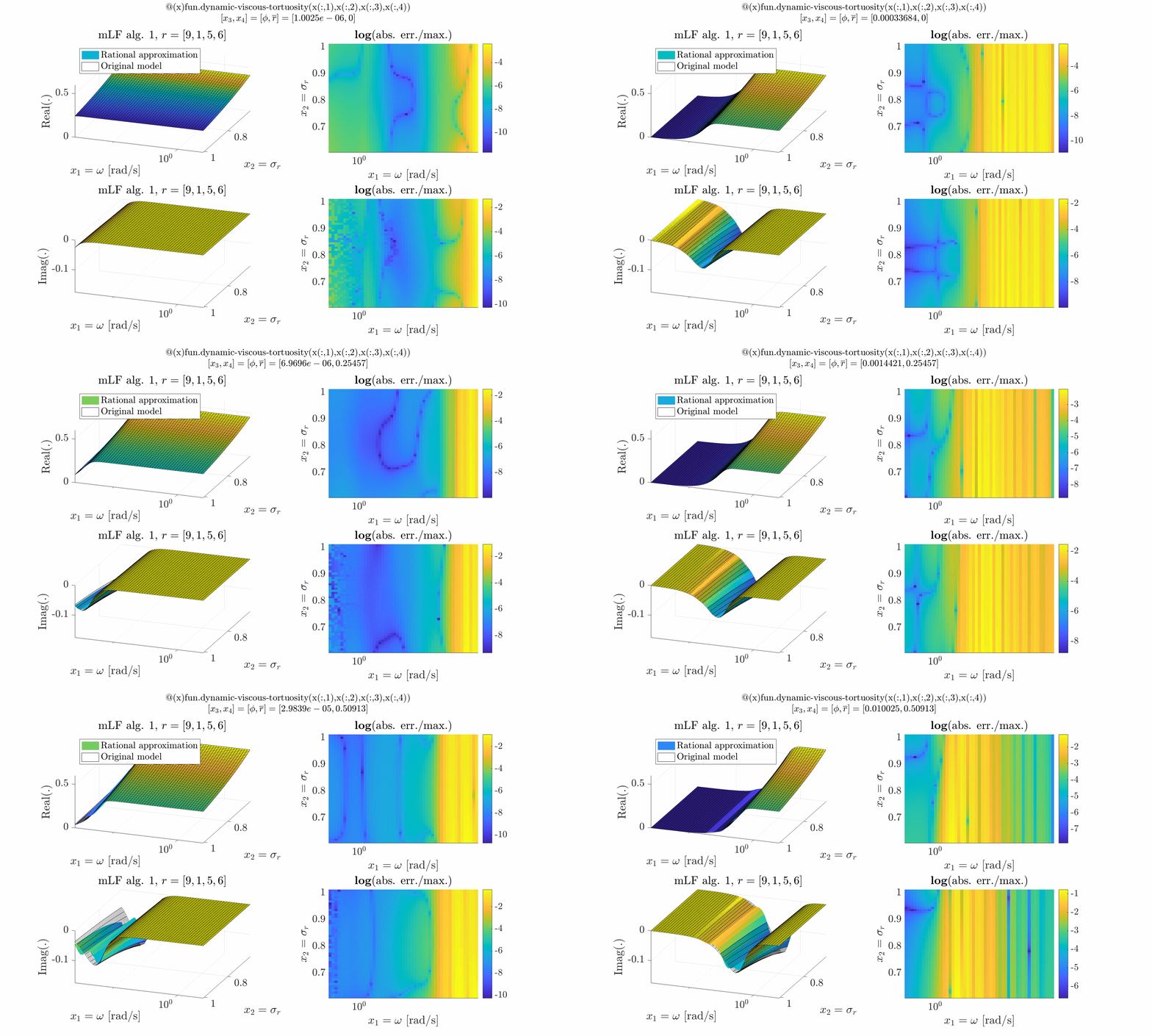
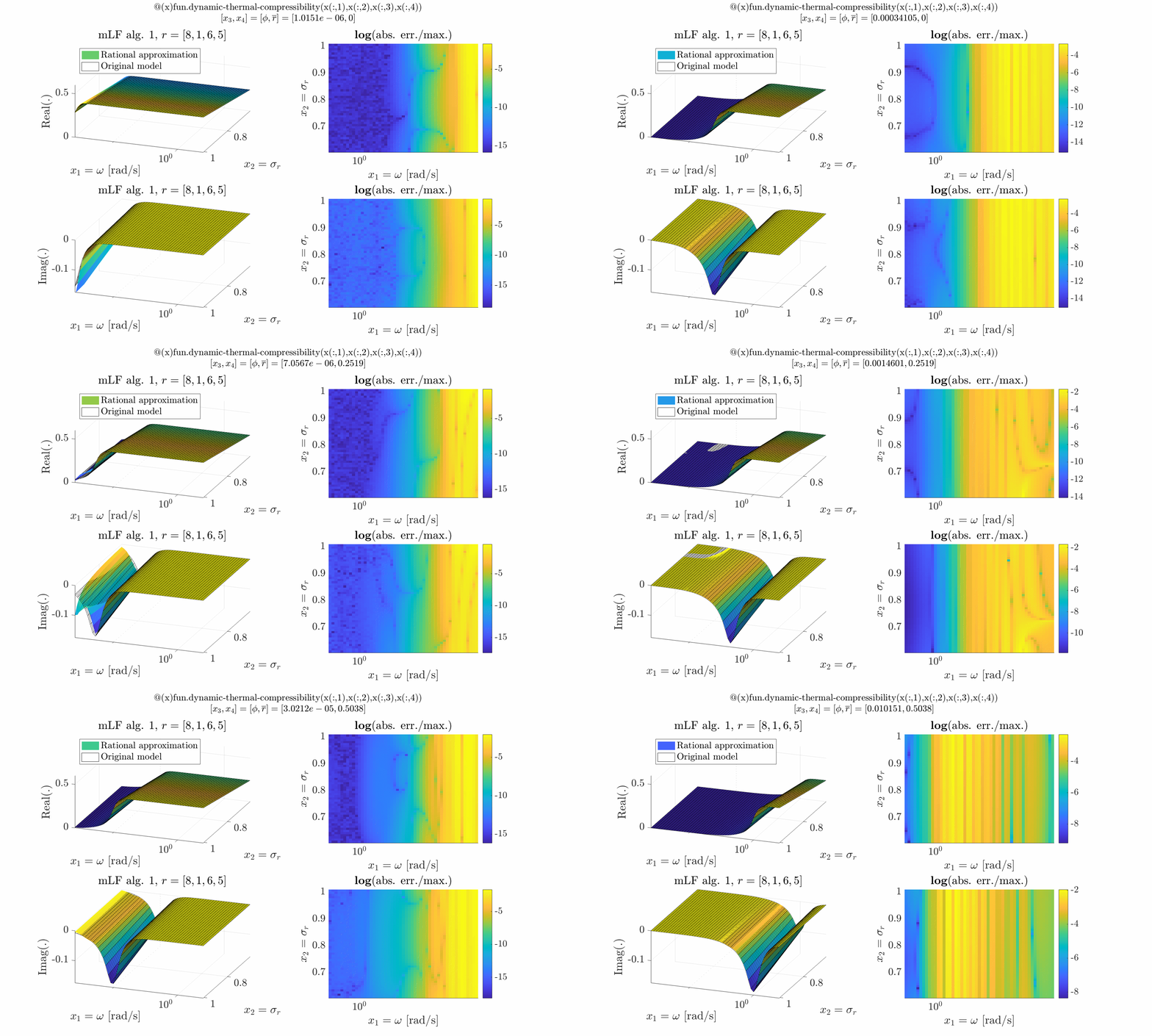
The below figure compares the original and its rational approximate functions along $\omega$ and $\sigma_r$, for varying $\phi$ and $\overline{r}$.
The frames show the value (left) and the mismatch (right).
First figure shows $\alpha$ (dynamic viscous tortuosity), the second is $\beta$ (dynamic thermal compressibility).
Now we can compute the material impedence ($Z$) and absoption ($A$) coefficients using the formula
$$
\begin{array}{rcl}
Z &=& -\imath \sqrt{\dfrac{c_1\alpha}{\beta}} \text{cot}(\omega h \sqrt{c_2 \alpha \beta})\\
A &=& 1 - \Bigg\lvert\dfrac{Z-Z_0}{Z+Z_0}\Bigg\rvert^2
\end{array}
$$
This can be done by evaluating the original and approximated functions
ZAref   = @(x) fun.impedence_abs(H_alpha,H_beta, x(:,1), x(:,2), x(:,3), x(:,4));
ZAapp   = @(x) fun.impedence_abs(r_alpha,r_beta, x(:,1), x(:,2), x(:,3), x(:,4));
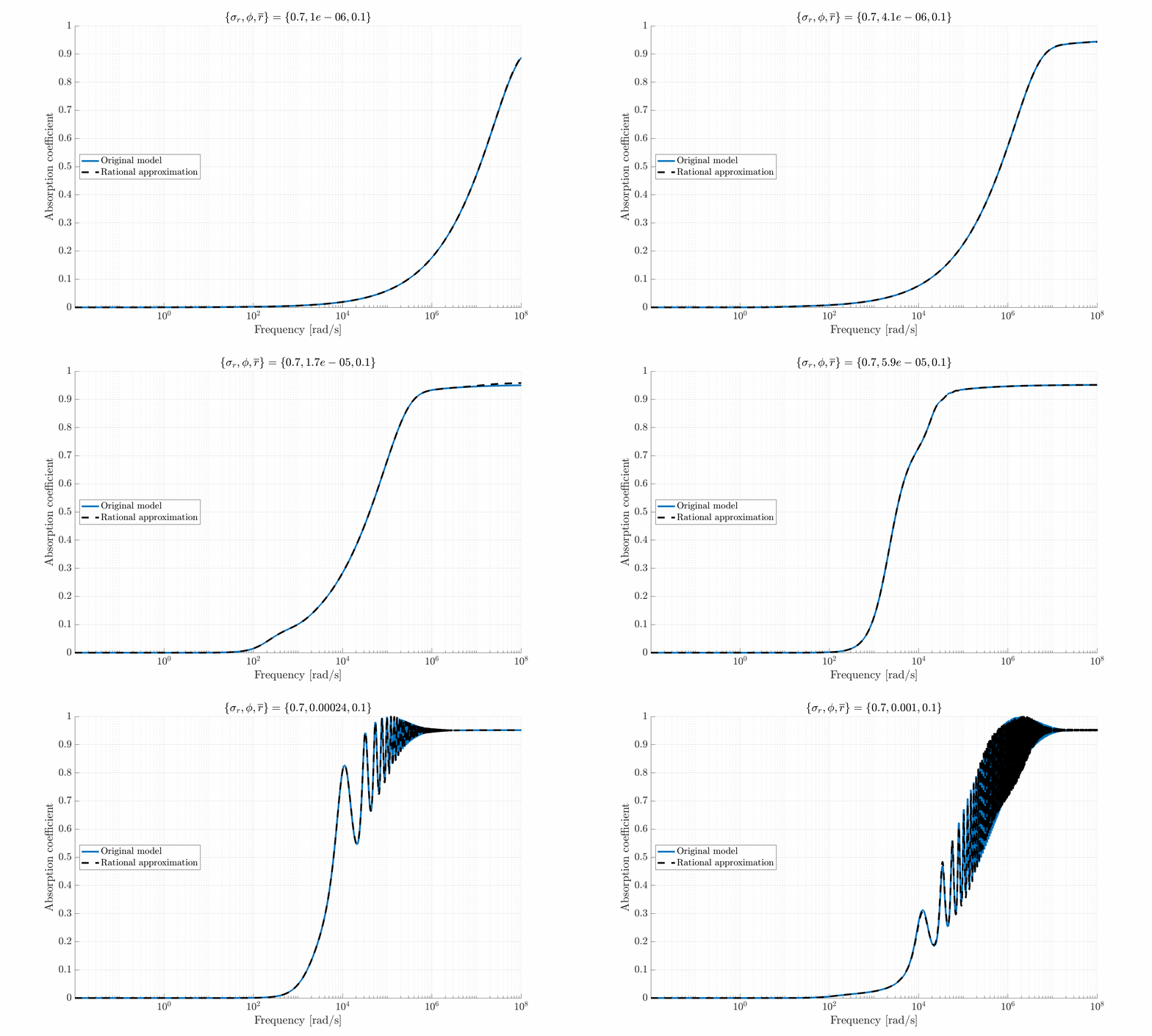
Evaluating these functions along $\omega$, the following absorption curves are obtained.
Reference
- L. Schwoebel, C. Poussot-Vassal, D. Matignon, R. Roncen, E. Piot and P. Vuillemin, "Application of the multivariate Loewner Framework to the modelling of acoustic propagation in rigid-frame porous materials", in Proceedings of the Waves conference, Montréal, Canada, June, 2026.