mLF (multivariate Loewner Framework)
Forewords
The mLF package implements - in MATLAB language - the Loewner framework for tensor-based multivariate rational modeling.
It provides an open source and turnkey package to implement the features introduced in the original article by A.C. Antoulas, I-V. Gosea and C. Poussot-Vassal, "On the Loewner framework, the Kolmogorov superposition theorem, and the curse of dimensionality", in SIAM Review (Research Spotlight), Vol. 67(4), pp. 737-770, November 2025 [arXiv].
The code provided is given for open science purpose. Its principal objective is to accompany the contributions by the authors (listed in the references page). It aims at being educative rather than industry-oriented. Evolutions (e.g. numerical improvements) may come with time, please check the GitHub page. Please, cite the references if used in your work and do not hesitate to contact us in case of bug or problem when using it, or even in case of success (we would be happy to include your case in the examples page).
For numerically more robust, scalable and versatile implementation, we invite readers and users to refer to the MDSPACK proposed library by MOR Digital Systems.
Overview
Features
The mLF package allows constructing a $n$-variable rational function approximating a $n$-dimensional tensor (either real or complex valued).
It is suited to approximate, from any $n$-dimensional tensor, (i) $n$-variable static functions, and/or (ii) $n$-variable parametrized dynamical systems.
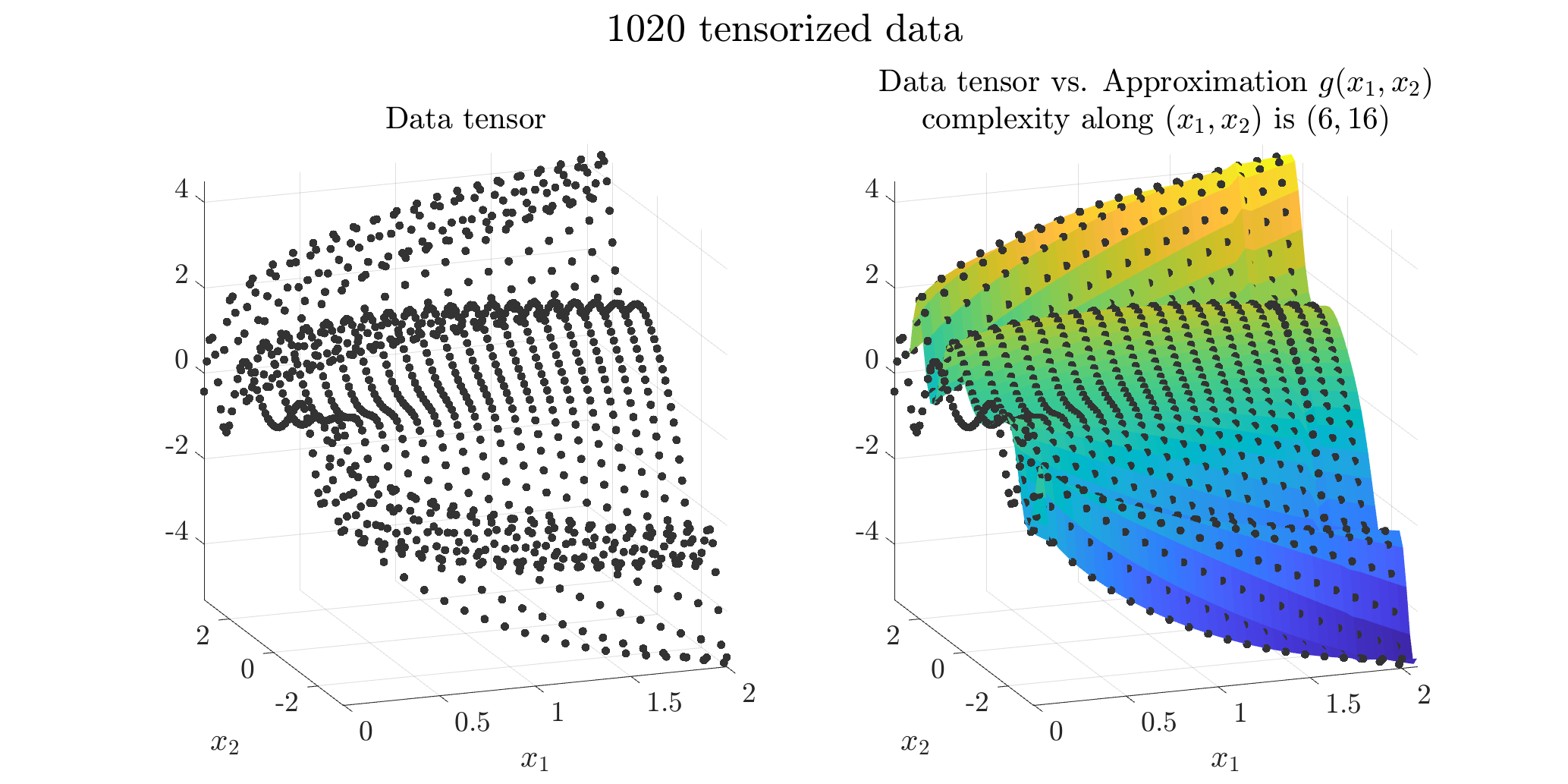
Illustration of a 2-variables tensorized data-based model construction.
Raw data generated from an irrational 2-variables model (left) and its rational approximation obtained with
mLF (right).Download page
You may obtain the mLF package from the GitHub page or either:
- by cloning the repository:
git clone git@github.com:cpoussot/mLF.git - by downloading the repository: ZIP
Dependencies
MATLAB R2023bor later (tested on this version).- Toolboxes:
Symbolic Math Toolboxmay be used for some functionalities (but not mandatory for most cases).
From tensor data to multivariate model
The main ingredient of themLF is a tensor data.
More specifically, this tensor is obtained by evaluating of the unknown function/process/sofware, denoted $f$, along the different values combinations of $(x_1,\cdots,x_n)$, thus leading to a $n$-dimensional tensor $\mathcal T^{\otimes}_n$.
$$
\left.
\begin{array}{rcl}
{\mathbf x_{1}} &=& \left[\begin{array}{cccc}x_{1}(1)&x_{1}(2)&\cdots&x_{1}(N_1)\end{array}\right]\\
{\mathbf x_{2}} &=& \left[\begin{array}{cccc}x_{2}(1)&x_{2}(2)&\cdots&x_{2}(N_2)\end{array}\right]\\
&\vdots& \\
{\mathbf x_{n}} &=& \left[\begin{array}{cccc}x_{n}(1)&x_{n}(2)&\cdots&x_{n}(N_n)\end{array}\right]\\
\end{array}
\right\} \Rightarrow \mathcal T^{\otimes}_n
$$
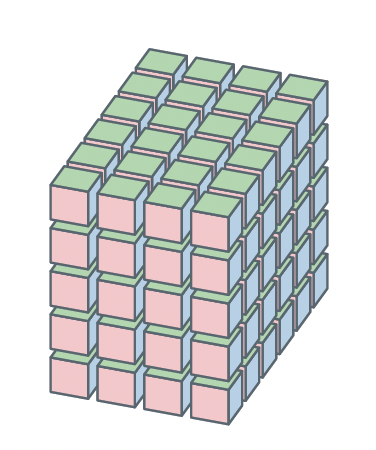
Illustation of a tensor data $\mathcal T^{\otimes}_n$.
$$ g(x_{1},\cdots,x_{n}) = \dfrac{\sum_{j_1=1}^{k_1}\cdots\sum_{j_n=1}^{k_n} \dfrac{c(j_1,\cdots,j_n)w(j_1,\cdots,j_n)}{(x_{1}-\lambda_{1}(j_1))\cdots(x_{n}-\lambda_{n}(j_n))}}{\sum_{j_1=1}^{k_1}\cdots\sum_{j_n=1}^{k_n} \dfrac{c(j_1,\cdots,j_n)}{(x_{1}-\lambda_{1}(j_1))\cdots(x_{n}-\lambda_{n}(j_n))}} $$ that approximates or discover the true unknown function $f$. See the getting started page to discover how, and visit the examples and references pages to view some other functionalities.
Contributions and main functionalities highlights
mLFachieves multivariate rational model construction directly from tensorized data;mLFallows constructing generalized realization form for rational functions in $n$-variables (in the Lagrange basis);mLFallows multi-linearization of $n$-dimensional nonlinear eigenvalue problems (NLEVP);mLFachieves variables decoupling; thus connecting the Loewner framework for rational interpolation of multivariate functions and the Kolmogorov Superposition Theorem (KST), restricted to rational functions;mLFconnects the approximation theory with systems and realization theories.
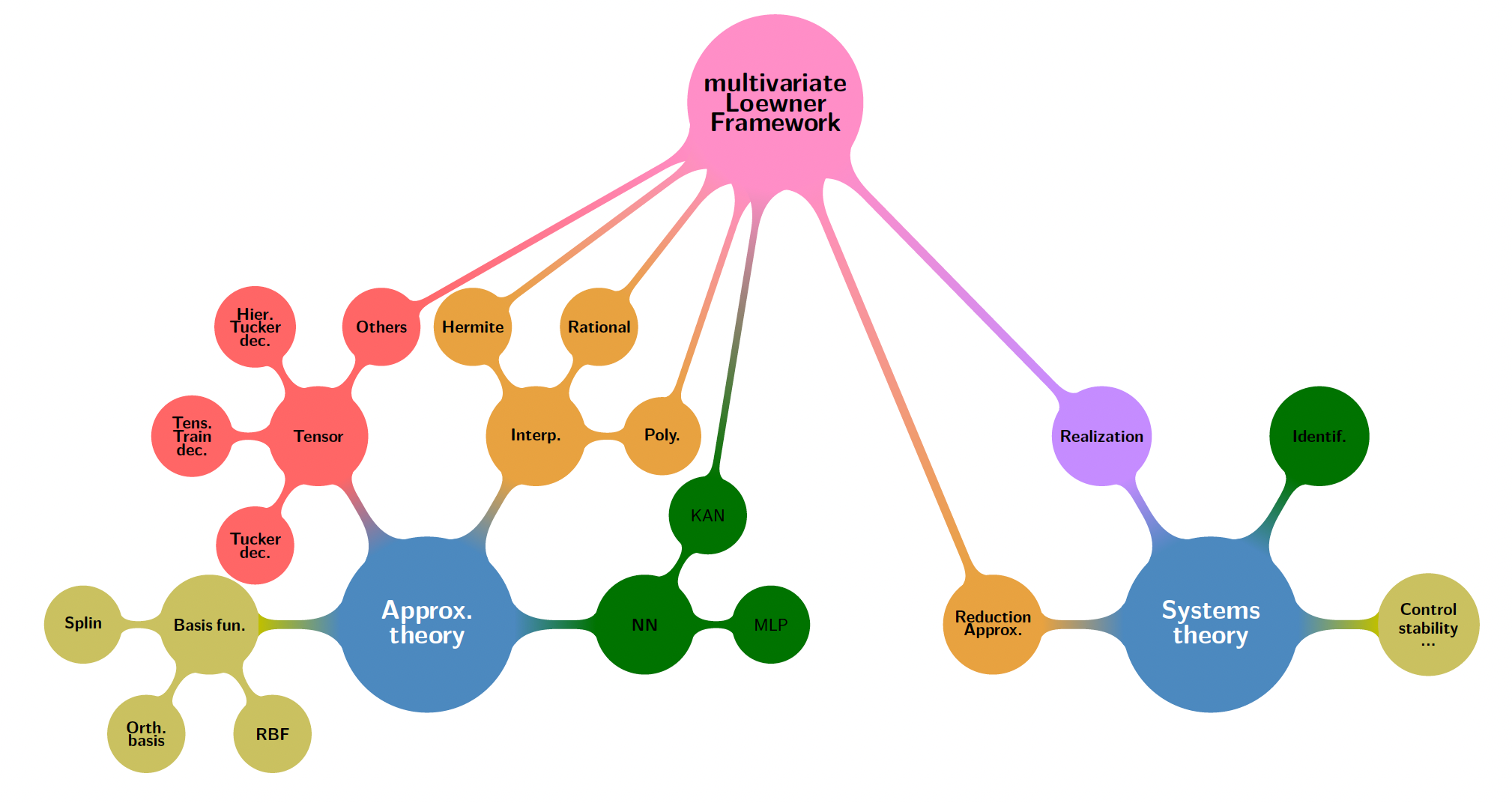
The multivariate Loewner framework is at the interface of dynamical systems and approximation theories.